Imagination is more important than knowledge.
Albert Einstein
Now, I’ll admit, this is where things get a little dicey in terms of this particular travelogue. It appears that at this point in the trip I abandoned my travel journal – unsurprisingly perhaps since the next and final chapter took place in the Somme and I am still processing my emotions from that part of the visit (stay tuned).
What does that mean, you ask? Well, it means my tale will continue on with the huge caveat that from here on out I am working from memory sparked by a skeletal itinerary and phone photos alone so…bear with me. From here on out, I know not what bits of my tale come from knowledge and which from imagination.
Regardless, I can say for certain that the emotions I impart will be real as I’ll be reliving them right along with you.
So…with that rather imposing disclaimer out of the way…let’s get to it, shall we?
Having spent quite a bit of time in Bayeux at this point, Dad and I decided it was time to head further afield before we made it to our third and final bed and breakfast – this time in the heart of the Somme.
Oddly enough, I think I somehow skipped our experience at the WWII museum in Bayeux over the course of these last few posts. Perhaps I’ll come back to that in a separate blog once I’ve finished moving through my memories of this trip…
But, back to our adventure, such as I remember.
Knowing we had some more heavy history ahead of us, Dad and I wanted to do some sightseeing entirely unrelated to either of the World Wars for a change. Where do two well-read, Mel Brooks-loving history buffs in France go when needing a break from tragedy, you might ask? Obviously to the closest they can get to Robin Hood and his Merry Men. I mean, they were merry after all. Should that not cheer us up?
But wait, you protest, you’re in France not England. What do you mean Robin Hood?
Well, dear reader, since I could not just skip over to Sherwood Forrest I did the next best thing: I took a short jaunt over to Richard the Lionheart’s Château Gaillard in Les Andelys which is wonderfully suited overlooking the Seine. Truly, the view was spectacular. Don’t believe me? See below!
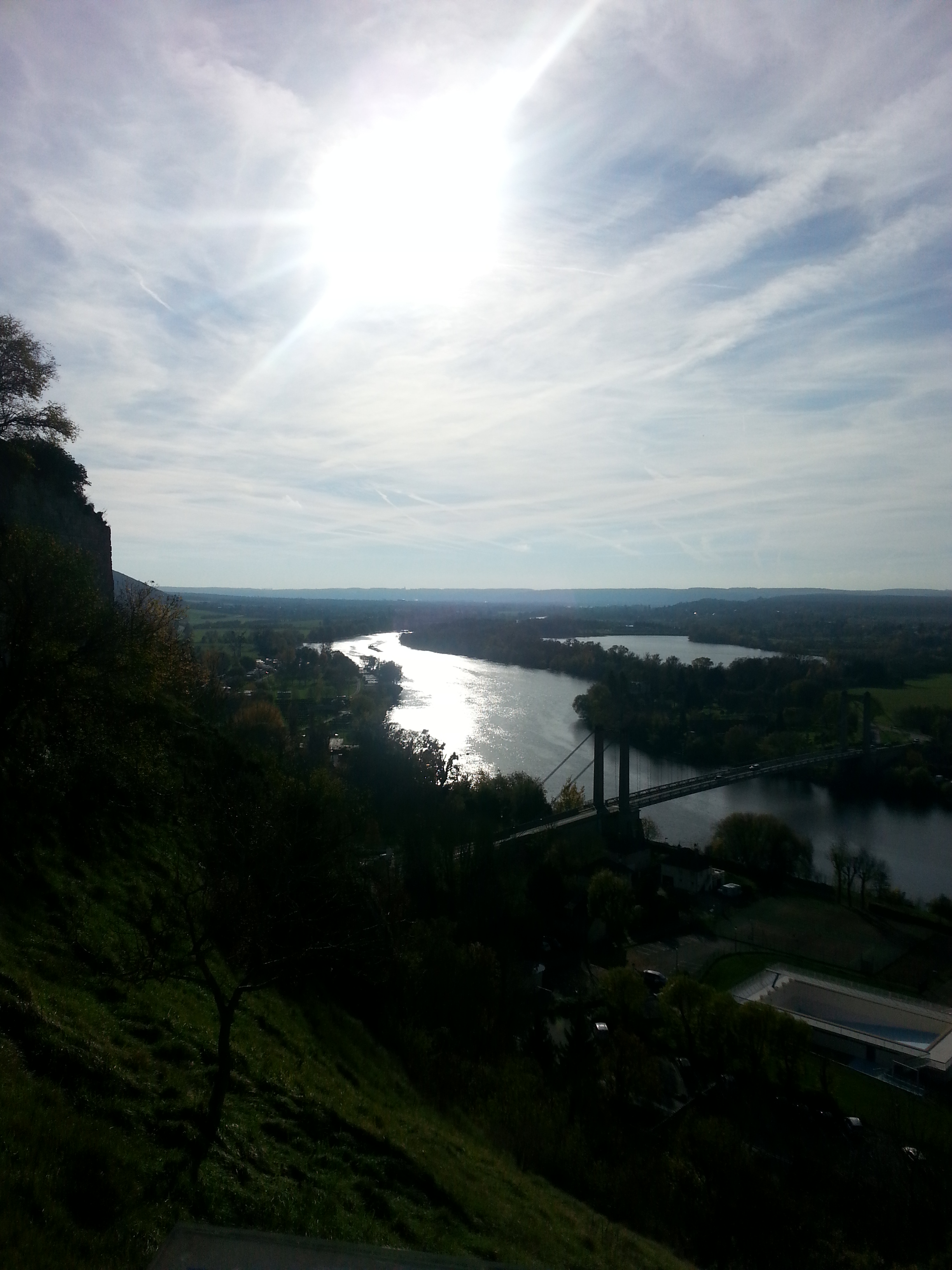
As I’ve mentioned many times before, I have unfortunately misplaced all of my camera photos from this trip and must rely only on those I took on my phone. If I ever do come across them (she said hopefully), I will come back and update these posts as honestly they were much better shots.
I’m bringing this up for the umpteenth time because there are a few images in particular which I’m very sad are missing from this post. Having made our way up to the ruins of Richard’s castle, dad took some great shots of me standing in what would have once been the castle windows. It’s rare that I willingly pose for a photo (and even more rare that I like the outcome) so the loss of these images really does hit me quite hard.
Ah, well. I’ll have to appease myself with the following image which was thankfully taken on my phone. Think what you will of Richard the Lionheart and his exploits (though Robin at least seemed to hold him in high esteem) but you cannot disagree that this castle is still magnificent even in its ruinous state.

Having driven as close as we could to the castle itself, Dad and I were happy to take in the views while walking the rest of the way up – even though the climb was pretty steep indeed. Thankfully, I was both younger and far more fit back then though I can’t say I skipped upwards with abandon.
Once we reached Château Gaillard I could not have been more pleased with what awaited us. Being somewhat of a thrill-seeker (surprised?), I have always loved how northern European ruins don’t have much by way of safety precautions.
I know, I know, hear me out.
One of the coolest things about these ruins is that, within reason, you are basically left to your own devices in terms of exploring them. This is in contrast to the “ruins” we have here in North America (anything from a centuries-old fort to a semi-aged house which once, er, housed a politician) wherein you are given a very strict path to follow, usually lined by ropes, and almost always preceded by an official guide who does not hesitate to warn you of the importance of following the rules.
Now, I get why this is so. They don’t want to get sued. Kidding. Sort of. They want to keep their visitors safe (and…not get sued). But in northern Europe this is not generally the way things are done. Obviously there are downsides to this (I have shared previously about how I almost fell off the Cliffs of Moher) but if you’re very careful it can lead to some truly intimate explorations of sites whose age completely boggles the mind.
Richard the Lionheart’s castle was one such place. Dad and I traipsed freely through the ruins, taking time to imagine what the place might have looked like in its heyday and reflecting on how it was left to crumble in the first place. Which leads me to…
Random Historical Fact #24
You thought I was done with these didn’t you? OK, so I forgot about them temporarily…a wee smidge. But they’re back baby! Today’s Random Historical Fact is brought to you by the big man himself: Richard the Lionheart! And, well, some internet research since Richard couldn’t come to the phone at this time.
This particular castle was like a child to ol’ Richard. No, really. he is quoted by military historian Allen Brown as exclaiming, “Behold, how fair is this year-old daughter of mine!” when the castle was almost completed after only a single year of construction (which, yes, was as much of an impressive feat as it sounds). In fact, since the Pipe rolls for its construction contain arguably the earliest details of how a castle was built, we have an inkling of just how involved Richard was in its creation. Though the rolls list everyone working on the castle from miners to masons and water carriers to soldiers, there is no master mason mentioned (traditionally the overall architect of the project). As such, Brown has argued that this may be because Richard himself took on this role – a claim supported by the fact that he was literally constantly popping in during construction. So…when Richard the Lionheart was in France his obsession was creating this castle which he claimed was so perfectly situated that he could hold it even if the “walls were made of butter”. Was this what he was doing instead of coming home to ensure that Robin and Maid Marion could get married? At any rate…he was only able to enjoy his “baby” for a single year before he died from an infected arrow wound in 1199. All that effort for naught. Sorry, Rich.

Well, Richard the Lionheart may not have had much of a chance to enjoy the castle properly, but we sure did. If I remember correctly, we spent a few hours there at least in the golden sunshine of that November morning and it could not have been a more welcome breather from the war-heavy trip thus far.
The rest of that day, however, would end up being far more emotional than we could have guessed in those sunny moments high above the Seine. But that, my friends, is a tale for another time.
This, dear reader, is how I imagine that day at Château Gaillard transpired. And I do believe I have done it some justice, to the best of my knowledge. But, at the end of the day, what is imagination but knowledge transformed into something grander?
So, remember, whether it is the one you imagined or the one you know: life is beautiful.
xo Erin

 Erin of the Hills