And now that they were long gone, these intriguing remnants of the lives they’d led were all the proof that remained that they had ever been here.
Mike Gayle, The Museum of Ordinary People
I came across the quote above while reading Mike Gayle’s wonderful novel and it struck me once again when I started to think about this long-overdue chapter of my France travelogue.
It seems a lot of the novels I’ve been reading lately have been focused in some way on what we leave behind when we exit this plane. I guess it’s something I myself have been thinking about a lot since I had children. It’s both nice and heartbreaking to think that my two beautiful daughters will be the majority of my legacy. Discussions about instinctual procreation aside, I love the idea that once (many, many, many years from now) I’ve moved on from this life, a part of me will live on in them.
Cue “He Lives in You” from The Lion King.
That miracle being acknowledged, I hate the thought of ever leaving them. Even if they too have already lived long and full lives once my time comes.
Wow. That got dark. Moving on.
Something else I thought about in preparation for this post is that even people as famous as Richard the First of England and Joan of Arc of France did not leave significantly more stuff behind when their time on earth ended. Sure, the Lionheart has left castles and jewels and progeny but…as far as material evidence of who he really was at his core? Not much.
The ultimate equalizer, death.
On the subject of Richard I, after having thoroughly explored the ruins of Chateau Gaillard, Dad and I decided to drive into Rouen to find something to eat for dinner.
Did I say dinner? What I meant to saw was North American dinner which obviously (perhaps understandably) means nothing to the French. Basically, our stomachs had betrayed us in signaling the need for food several hours before it was going to be widely available.
So, valiantly ignoring the protestations from our empty digestive systems, we decided to walk around little in order to give the local restaurants time to catch up with out admittedly foreign schedules.
Thinking back, despite the fact that I was likely hangry for most of our rambling that night, I’m glad we decided to give Rouen a bit of our time as we would not be returning on this particular trip. The next day we were slated to head to the Somme for the final leg of our journey and I would have been kicking myself later had I not devoted at least a few hours to such a storied part of France.
It’s truly amazing to me what the mind holds on to so many years after an event or adventure occurs. I’ve always had a visual memory but, still, having access to such a rich trove of mental photographs (especially considering I lost so many of my actual photographs…) 10 years on is extraordinary. That being said, maybe Dad will correct me on this recollection but…here goes.
I have a very clear memory of stopping along a forested road to take a peek at another ruined religious relic. This one was by a stream or a river of some sort, the remnants of its former glory reflected in watery form along its base. It was, and still is, confounding to me that we had come across so many colossal architectural skeletons in France. Here in Canada, the majority of our “ruins” constitute long-abandoned barns on private land that have already been rebuilt for purpose. Their former lives are well-known by the current owners of the land while the majority of these masses of stone and wood in France remain unmarked with any attempts at remembrance.
From what I remember, this was another one of those forgotten places, overgrown and underappreciated. However, if you recognize this particular beauty, please let me know!

Having breathed in a good amount of country air, we drove into the city to find parking along another tranquil body of water. Having secured a resting spot for the car, we got our bearings and walked leisurely in the direction of the famous Rouen Cathedral. As previously mentioned, it’s not like we needed to rush to find a seat in the still-slumbering local restaurants. It was, after all, only 4PM. They likely had not yet even begun to prepare their dinner service.
We located the cathedral in short order thanks to its imposing size. Even in the big city it stood out. Walking from the dazzling sunlight glancing off the soaring facade into the cool gloom of the interior had us taking a few moments to rub our eyes so they could adjust to the dark. Though I’m sure the inside of this stone giant looks spectacular all lit up, there’s something very peaceful about the enormous space filled with shadow. The intermittently-placed candles are a nice atmospheric touch, especially when there is something to read, but I must say that I prefer the serenity of the darker corners tucked away from the bulk of the ever-present tourist crowd.
Rather surprisingly, it was in one of these dimly-lit areas that I realized we weren’t quite done with the Lionheart just yet. Or he wasn’t done with us. Having done no prior research upon walking through the massive wooden doors, I didn’t realize this was where the famous king’s heart still resided. Oddly (or perhaps not for the time period) his entrails were entombed in Chalus, where he died, and the rest of him at the feet of his father’s body in Anjou at Fontevraud Abbey. The most intriguing part? For such a “great” man this tomb was…underwhelming. Would it have been grander had it been erected in England where he was arguably more admired? I’m not sure, considering most of this admiration comes more from modern iterations of the Robin Hood legend than actual historical achievements on his part.
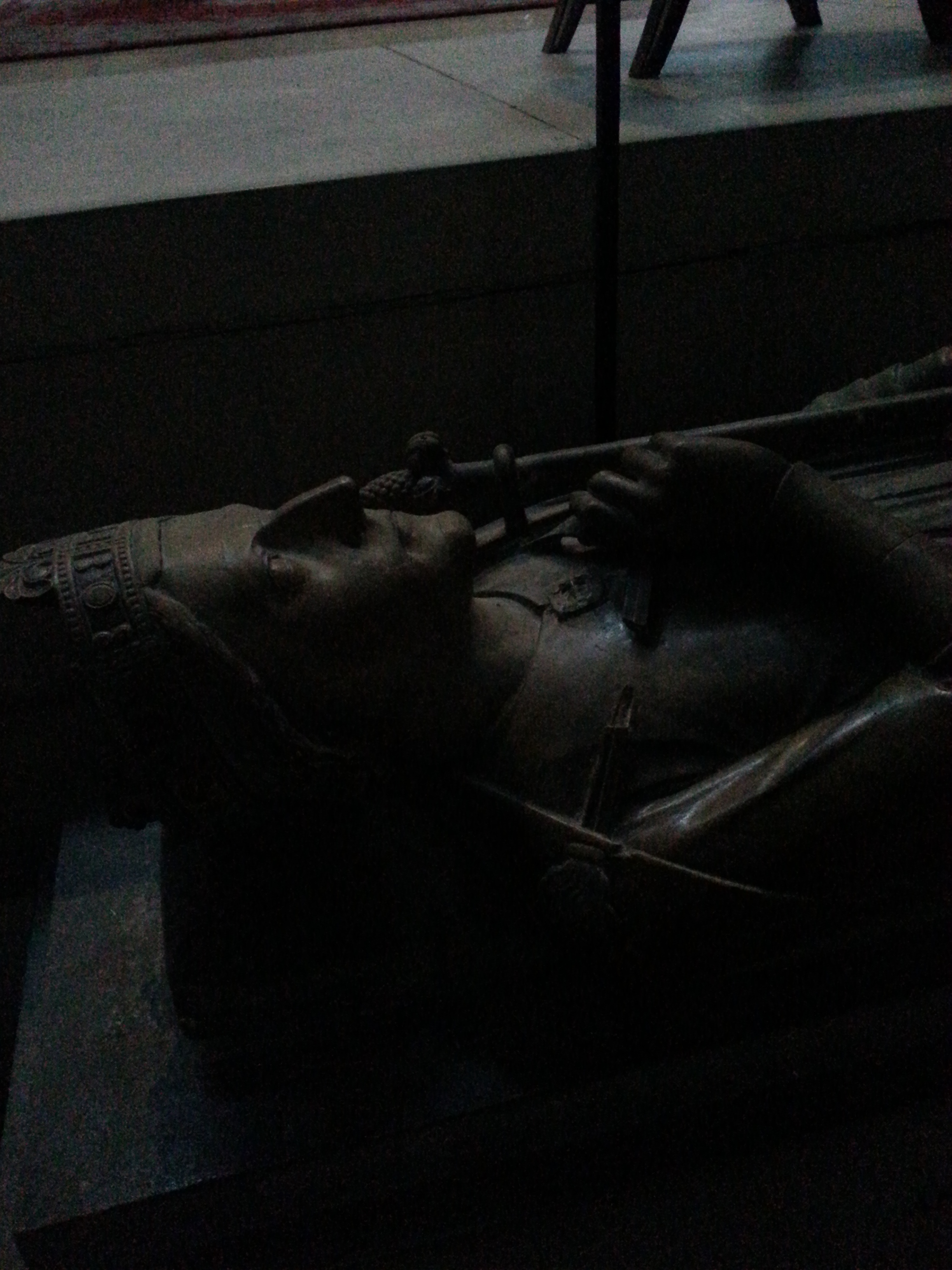
Random Historical Fact #25
Before we finally leave Richard I’s company for the remainder of this travelogue, I can’t help but highlight a fascinating tidbit of his life…or more accurately his death. During the siege of the virtually unarmed castle of Châlus-Chabrol, the king was wounded with a crossbow bolt to the shoulder. While this might not have proved fatal on its own, considering the unhygienic standards of the day it soon became infected with gangrene. Realizing he was dying, Richard had the offending crossbowman brought before him to determine his fate. Turns out, the deadly soldier was but a boy (so young, apparently, that the various historical chroniclers couldn’t be bothered to confirm his name) who said he had intended to kill Richard to gain revenge for the deaths of his father and two brothers at the monarch’s hand. Understandably, this brave kid expected to be executed for dealing the killing blow to the king of England. Instead, Richard somewhat confusingly pardoned him imploring him to “live on and by my bounty behold the light of day”. The dying Lionheart even, allegedly, sent him away with 100 shillings! Now that’s the Lionheart the legend of Robin Hood taught us to love…I wish the story ended there. However, apparently once Richard I had breathed his last breath in the arms of his mother, a mercenary captain had the poor boy flayed alive and hanged. So much for mercy.
Thankfully, I did not know this story at the time otherwise my appetite may have been unjustly abated with thoughts of this gruesome execution. Instead, unable to ignore our growling stomachs any longer, out we traipsed in the hopes that our temporary patience would be rewarded with at least one or two eateries opening early. Would someone please take pity on these starving North Americans?
We followed some signs to a nearby market square hoping the fact that it was both named and included on tourist signage meant it would provide what we needed. After all, Place du Vieux Marche seemed to promise food of some sort. No?
The tourist gods must have been watching out for us that day because not only did we find something delicious (though decidedly not French) to eat but we found yet another fragment of a life once lived. This one cut all too short.
Turns out our stomachs had unwittingly led us to the location where Joan of Arc had been burned at the stake in 1431. It’s an odd location though perhaps typically French in its lack of gaudy commemorative artwork (see my post on Utah beach for an American example of exactly this – with no disrespect to those individuals who actually laid down their lives on that strip of land).
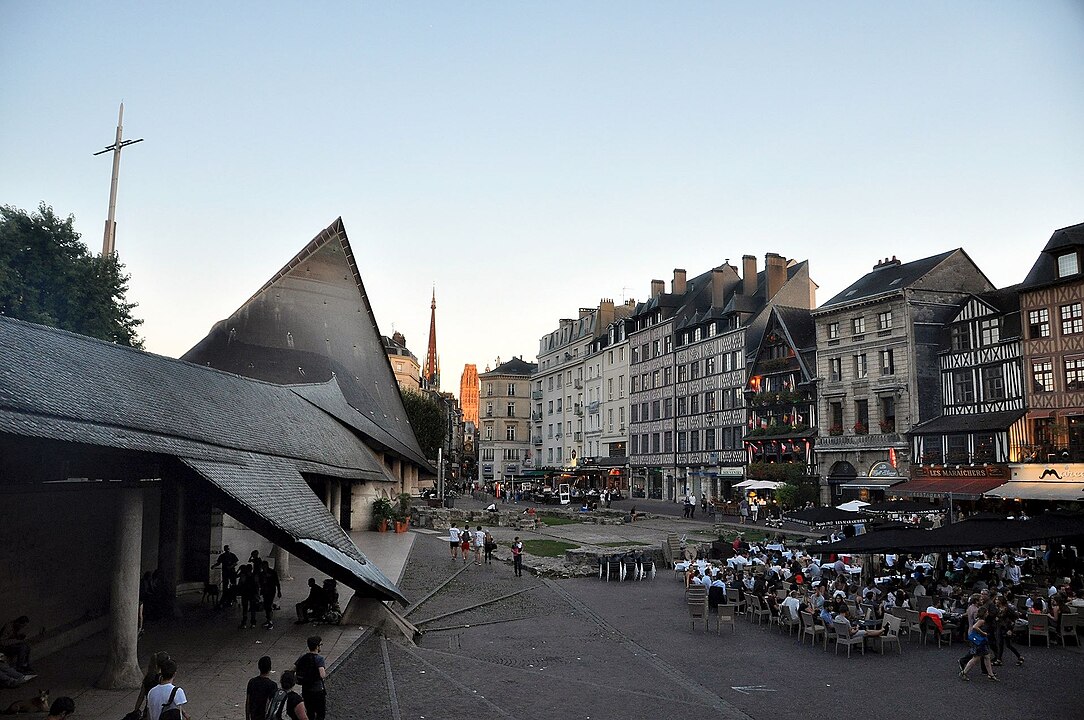
In the exact location where Jean was burned and consequently had her life snuffed out, there is a modernist church, a little incongruous in its own right, and a single cross soaring 65 feet in the air remembering the Maid of Orleans. I have since learned that the design of the church is intentional, built with huge windows featuring stained glass panels salvaged from a 16th century church destroyed nearby during the war. The angular walls, almost militaristic in their structure, are apparently supposed to represent the flames that enveloped her execution pyre. The purpose of the design is to keep the focus on the towering cross, a huge and yet somehow understated iron construction shaped like the Cross of Loraine which was a symbol of the French resistance during WWII. So, basically, a multipurpose structure built to remember all those who had laid down their lives, centuries apart, for their beloved country.
All that is absolutely beautiful, of course, but what I saw when I visited was an austere facade taking the place of what had once by a garden and meeting place. In this space where hundreds had once crowded to witness this young woman’s final moments, each with their own private motivations for doing so, there is no longer much space to gather. There is a mass held every year on the anniversary of her death but only a small number, comparatively, can attend. Perhaps it has changed since I last visited but my feeling last time I was there was one of stifling overcrowding. Then again, maybe that’s just yet another remnant of Joan – the lingering of the sensations she might have felt while being led to her death through the crushing crowds.
After spending a few minutes paying our respects to this courageous young woman, we had finally reached the limit of our admittedly far-from-starvation hunger. Luckily, we found a pizza place right on the square which had recently opened for dinner service (probably for tourists like us considering how early it was).
Happy to sacrifice our attempts to not stick out as foreigners in exchange for full bellies, we tucked in to some delicious oven-fired pizzas only a little uncomfortable that flames cooked our meal feet away from where they consumed a woman in her prime.

If I thought I was uncomfortable in that moment, though, I had no idea what was awaiting me the next day in the Somme. Meagre as they seemed, the remnants we had found to mark the existence of Joan and the Lionhart were monolithic compared to the evidence that remained of the hundreds of thousands of individual souls lost on the battlefields of the North. And we were woefully unprepared for the proof of this immense loss.
But, don’t worry. The last few entries won’t be wholly dark. Because even when facing the fact that one day we too will be long gone, like so many others before us…
Life, this life, is Beautiful.
xo Erin

 Erin of the Hills